Japan’s gesture of goodwill and lessons learnt for Sri Lanka
Sri Lanka and Japan: The Organic relationship
As I embarked on the fellowship program offered by Japanese government towards achieving the objective of developing multi layered network of Japan experts among international scholars, analysts, think tankers I felt privileged and humbled at the opportunity to gain a comprehensive insight into a nation I personally admire and see many linkages with my own country.
Sri Lanka and Japan may not have long historic ties may not be in the same maritime neighborhood, we are connected by destiny as two nations that felt each other’s heartbeat and connected at moments when the whole world seems thinking otherwise. The global conditions in which Sri Lanka and Japan that connected in the aftermath of the Second World War is no more, both countries have evolved and transformed, unfortunately for Sri Lanka internal conflicts, political upheavals and economic crises has pushed us to a difficult position. Japan, while becoming one of the most advanced and sophisticated societies and whilst sharing its own challenges had remained a steadfast and all-weather friend of Sri Lanka. Whilst in diplomacy it is said that interests trump everything else, in case of Sri Lanka and Japan more than anything the friendship remains a constant.

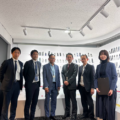
①With Murotani Masakatsu (Director Southwest Asia Division), Iwase Kiichiro (Deputy Director) South West Asian Division, Hasegawa Yuki from South West Asian Division
My visit to Japan is important not just because of the brief historical context or how we have evolved as two nations but it’s important as we are both entering an era of intense turbulence, transformations and geopolitical competition that is heighted. Thus, irrespective of what stage of political transformation internally we are in the external strategic environment both nations have inherited are generating unprecedented levels of influence that reverberating across domestic
Sri Lanka’s Transformations
As a strategist and policy researcher in the field of security, in time when Sri Lanka has undergone a historic and somewhat radical transformation in its domestic body politic with a presidency and government with more than two thirds majority coming into power disrupting the continuation of the established power blocs of mainstream politics, my concern remained about the security sector and its future in Sri Lanka. Primarily the way forward in the national security philosophy, strategy and policy. No matter what the domestic transformations were Sri Lanka had to come into terms with the realities of its external security environment and the domestic compulsions of its own citizenry, the two are critical for the forging of policies for the new administration.
There remains a yawning gap between the two as the domestic compulsions were inward looking yet with minimal comprehension of the big picture. The new government then has to introduce a comprehensive security solution whilst balancing the wide mandate they received mainly to deliver a systemic overhaul of economy, law and order, good governance, development and people’s empowerment.
Lesson for National Security Vision and Strategy
During my visit which included multiple engagements with state institutions from Ministry of Foreign Affairs, to Ministry of Defence, think tanks especially the Sasakawa Peace Foundation and its security studies program and the opportunity to address the 203rd Diplomatic Roundtable, focusing on ‘indo pacific as a strategic construct and its implications on small states’, organized by the Japan forum on international relations (JFIR), and meeting eminent intellectuals like Prof Hideaki Shinoda from Tokyo University of Foreign Studies and Dr Etsuye Arai created multiple opportunities to speak about Sri Lanka, the new administration’s outlook, Sri Lanka’s strategic environment and more importantly to learn much about Japan’s complex external environment and significant challenges and the transitions within Japan.

②Round table discussion on themes on regional and international security at the Sasakawa Peace Foundation with members of the Security Studies Program, session moderated by Dr Satoru Nagao.

③Meeting with Prof Hideaki Shinoda from the Graduate School of Global Studies, Tokyo University of Foreign Studies at MOFA HQ Tokyo.
Whilst the above experiences were eye opening, insightful, the most tangible outcome of this visit was my exposure to framing, working and insights into Japan’s national security strategy (NSS) and its link with the newly framed Japan’s Defence Strategy. This exposure came at a critical conjuncture from a Sri Lankan perspective as the new administration three months onto its time in governing is slowly but seriously contemplating the future direction of Sri Lanka’s national security and aligning Defence policy accordingly. Thus, gaining insights into the framing, the strategic logic of organizing the strategy and focus areas were key.
National Relevance
Sri Lanka’s and Japan’s strategic requirements and capabilities are incommensurable, yet the most applicable factor is the framing and key segmentations. Sri Lanka since the ending of the conflict in 2009 has gone through several rounds of drafting national security and Defence strategies with lead role played by an array of committees, in the president secretariat, ministry of Defence and National Defence College. The challenge has been that the various iterations of this not coming into the legislature and the inability to come up with a framework that is acceptable, pragmatic and is durable on its necessity and resilience enough to withstand change of political compositions.
In a series of discussions I had during my stay in Japan, my insights were expanded and deepened and it led to me to read and analyse, policy documents and the literature and the notes I took during my meetings, Sri Lanka is in dire need of a transformation in its security thinking and its defence reforms primarily driven by the re posturing of the military as a stated priority.
Application of Japanese experiences to National Discourse
I have already started to bring in the Japanese National Security Strategy document as a key template in state and civil society deliberations and encouraging young researchers to take a deep dive. The people centered approach to the document provides insights into how a state can primarily address and demonstrate its responsibility, of projecting the strategy as an integral part of the social contract which is a key take away especially for the new administration.

④Group photograph at the conclusion of the round table discussion at the Sasakawa Peace foundation with the team from Security Studies Program.
Then from that the structuring of outlining Sri Lanka’s national interests, basic principles of national security, analysis of the current security environment, the setting up of national security objectives, and finally the ways and means of achieving these through a strategic approach. The Defence component is integrated into this objective based approach which includes the whole of country Defence architecture and policies of cooperation that aligns well with articulated foreign policy interests.
The final take away came from my interactions with the officials at the Japanese Ministry of Defence, is based on a clarification that I sought, the question in focus was, what does this achieve primarily, the framing of a national security strategy and especially the significance of the document? His response was that the Strategy document was necessary for law makers to take to the legislature, and the ensuing debate in the legislature aided the dissemination of Japan’s national stances to the public. This observation remains singularly important as Sri Lanka’s failure in successfully drafting such policy documents has not been an intellectual or policy drawback instead it is mainly a failure at a strategic communication level. Where this debate has never taken place hence the vacuum is filled by unverified, non-data driven and non-rational, political narratives which dilutes the primacy and necessity of the strategy.
Conclusion
My visit to Japan after a 20-year lapse from my previous visit to the country show cased a more open, more vibrant yet more challenged Japan than it was in 2004, yet it helped me more than before to connect with the objectives of the program and to find tangibles that are nationally relevant. I feel that I can do more to Sri Lanka in the realm of national security and Defence strategy framing and to developing a narrative around it using Japan’s experience which are more acceptable to a highly opinionated strategic community who has strong reservations when drawing examples or experiences of USA, India and China. The reference to an all-weather friend who has an overall positive view among Sri Lanka’s public and policy community alike may lead to a pragmatic application. Time will tell the real outcome, but the effort has already commenced, and Japan has given me the reasons to have more hope this time.

⑤Presenting my edited Publication titled ‘Shared Vision for the Indo Pacific: Implications for South Asia’ a historic book which is the first policy research publication of the Kotelawala Defence University (KDU) Sri Lanka.
 Dr. Harinda Vidanage