Towards Greater Regional Integration in Southwest Asia: Leveraging Japan’s Experience, Programs and Partnerships
1.0 Introduction
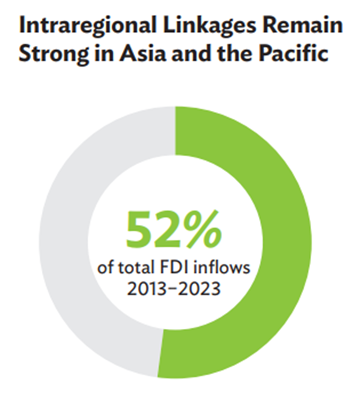
Figure: Asian outward investment ($ billion)
*PRC = People’s Republic of China.
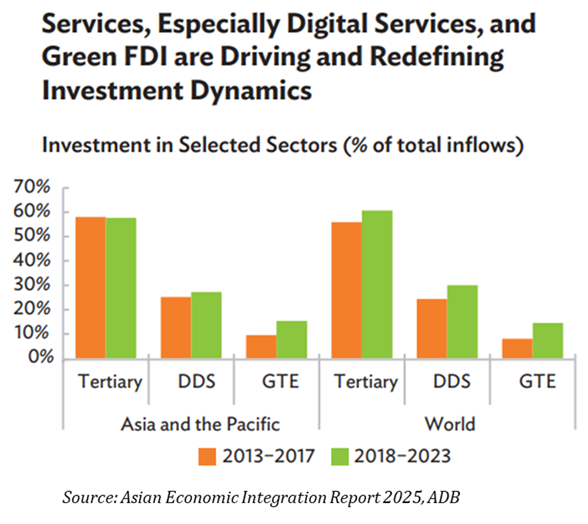
Regional integration is the process of countries cooperating across borders for economic, infrastructural, and strategic gains is gaining momentum across Asia. Institutions like BIMSTEC, BBIN, and ASEAN are facilitating greater connectivity, enhanced trade, and collective resilience. Asia’s deepening ties are evident in FDI trends, with intraregional flows averaging 52% from 2013–2023, driven largely by services, which grew from 46% to 58% of FDI share in the past decade. [1]
As Asia pivots toward digitalization and green transitions, strategic partnerships are reshaping investment priorities. In this evolving landscape, Japan has emerged as a key architect, contributing 30% of regional and 10% of global FDI outflows, with a strong 11% annual growth well above the regional 5% average. Through targeted ODA, quality infrastructure investment, and engagement in platforms like the Partnership for Quality Infrastructure (PQI) and Japan–Mekong Connectivity, Japan is shaping South Asia’s regional integration, notably in Bangladesh, India, Sri Lanka, and Nepal
Source: Asian Development Bank 2025
Digital and green industries have emerged as key drivers of investment, with climate-related greenfield investments rising from 8% to 27% of the total, fueled by renewable energy and electric vehicle supply chains.[2] However, geopolitical tensions and evolving industrial policies have reshaped global investment flows, with trade-exposed sectors facing sharper declines.
2.0 Criticality of Regional Integration in Southwest Asia for Shared Economic Growth and Development
The pivotal position of Southwest Asia between East Asia and the Middle East makes it strategically crucial for the ‘Free and Open Indo-Pacific (FOIP)’. With a vast market, growing consumer market and a large youth workforce, this region harbors immense economic potential, particularly in sectors like trade, manufacturing, and digital services, as well as opportunities for regional value chains and renewable energy cooperation. However, challenges such as poor infrastructure, weak education and healthcare systems, and high poverty levels prevent this country from tapping into its potential.
Currently, regional trade in Southwest Asia remains low, accounting for less than 5% of total trade.[3] Regional economic integration can be key to increasing trade and attracting shared economic prosperity by reducing trade barriers, harmonizing regulations, and improving connectivity. In this region, opportunities for integration include developing regional value chains, expanding digital trade, and promoting energy cooperation. External actors like Japan can play a key role in supporting regional development, provided their involvement aligns with South Asia’s integration goals.
2.1 Why Regional Integration Important for Bangladesh?
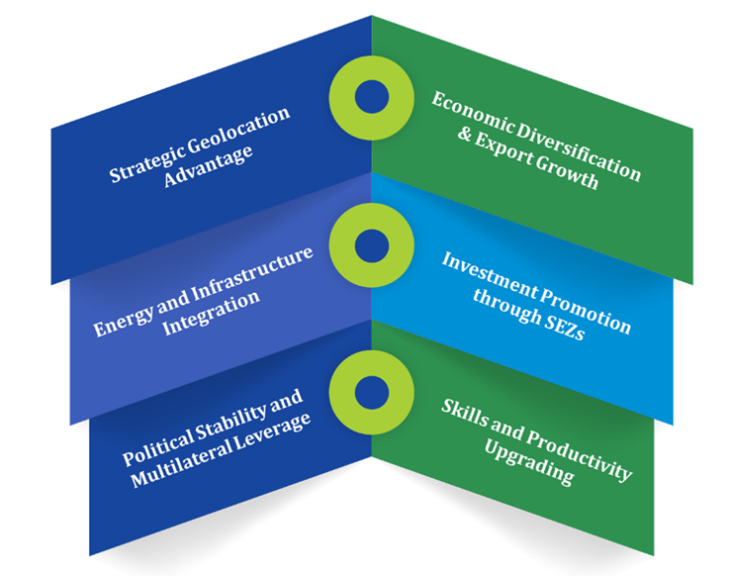
Table: Japan’s Bilateral ODA in Southwest Asia Region (2022)
- Leveraging Strategic Geolocation Advantage: Located at the crossroads of South and Southeast Asia, Bangladesh provides the shortest land route connecting the landlocked Northeastern Region of India with the Bay of Bengal. This positioning enables it to act as a gateway for regional connectivity under BIMSTEC and BBIN frameworks.
- Economic Diversification & Export Growth: Although around 75% of Bangladesh’s imports come from Asia, only 16% of its exports go to Asian countries.[4] Regional integration offers the potential to diversify beyond its current RMG-heavy export basket and tap into ASEAN+3 markets with a combined GDP exceeding $28 trillion.[5]
- Energy Sustainability and Infrastructure Integration: Bangladesh participates in regional energy cooperation projects like the SAARC Framework Agreement for Energy Cooperation and the India-Bangladesh electricity grid, importing over 1,160 MW from India.[6] Japan-supported infrastructure projects like the Matarbari Deep Sea Port will link Bangladesh with regional production networks via BIG-B and BIMSTEC corridors.
- Investment Promotion through SEZs: Regional cooperation has led to Japanese and Indian investments in SEZs like Araihazar (Japan Economic Zone). These SEZs are designed to support non-RMG sectors, with the government targeting $20 billion in FDI by 2030.[7]
- Political Stability and Multilateral Leverage: Platforms like BIMSTEC enhance regional peace and cooperation, facilitating joint mechanisms on disaster response, climate change, and trade negotiations areas critical to Bangladesh’s diplomatic strategy and security posture.
- Skills and Productivity Upgrading: Regional integration can drive demand for skilled labor in non-RMG sectors. However, Bangladesh still ranks 102 out of 141 in skills and innovation capacity (Global Competitiveness Report), highlighting the need for targeted reforms in education and industrial policy.[8]
3.0 Japan’s Support for Regional Integration: Lessons from Southeast Asia and Opportunities in Southwest Asia
3.1 Enabling Diplomatic Cooperation
Efforts toward regional integration in East and Southeast Asia have often been tempered by persistent undercurrents of historical discord and deep-seated strategic competition. Despite the institutional mechanisms like ASEAN+3 and the East Asia Summit offering platforms for dialogue, the absence of a coherent and inclusive regional security framework reflects enduring fractures.[9] Lingering tensions rooted in legacy disputes from the mid-20th century continue to complicate trust-building across key regional actors.
In this context, Japan has positioned itself as a steady and pragmatic actor—advancing structured partnerships and development-oriented diplomacy, particularly within ASEAN. Its efforts often serve as a stabilizing counterweight amid shifting alignments and growing regional anxieties over strategic dominance. While certain powers expand their influence through narrative framing and expansive connectivity initiatives, Japan’s approach focuses more on institutional reinforcement, human resource development, and normative engagement.
Tokyo’s consistent support for ASEAN centrality—through forums like ASEAN+1, ASEAN+3, and the Regional Comprehensive Economic Partnership (RCEP) reflects its long-term commitment to multilateralism.[10] However, the deeper political convergence required for sustained regional integration remains constrained by an undercurrent of strategic caution.
3.2 Catalyzing Investment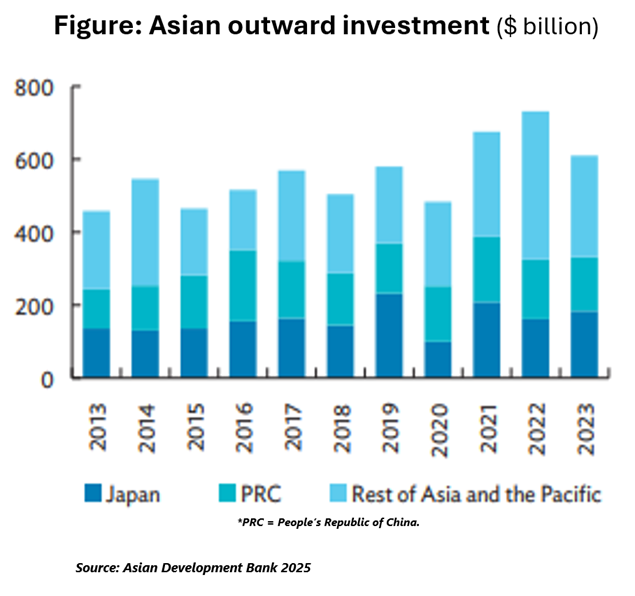
Japan continues to be a cornerstone investor in Southwest Asia and South Asia, maintaining its role as the region’s largest Asian source of outward FDI over the past decade. Between 2013 and 2023, Japan accounted for roughly 30% of regional outward flows and 10% of global outflows.[11] This long-standing investment trajectory is not only quantitatively significant but also qualitatively focused on high-tech and infrastructure sectors.
In Southwest Asia, Japan’s development financing reflects both scale and strategic selectivity, as highlighted by grant and loan allocations. Japan provided over $3.8 billion in gross government loans to India, followed by $2.37 billion to Bangladesh and $154.6 million to Nepal, reinforcing a clear pattern of prioritizing infrastructure-heavy economies with regional connectivity potential.[12]
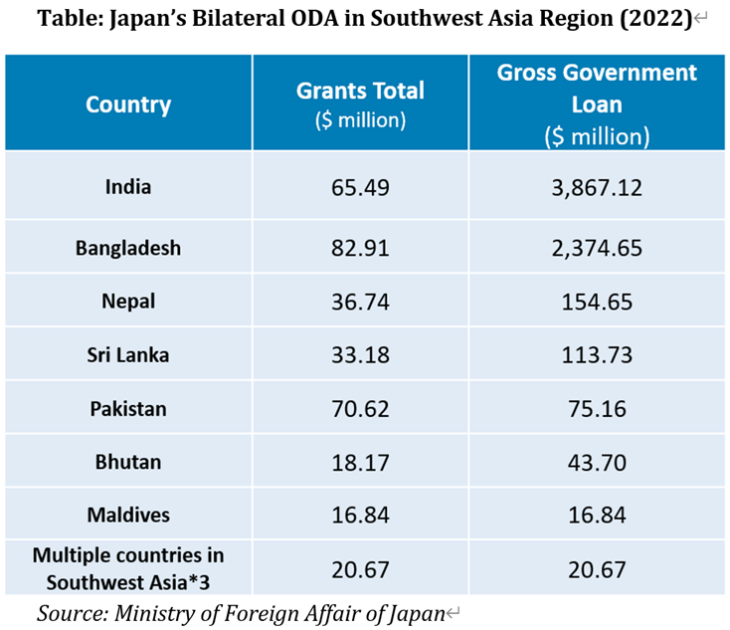
Source: Ministry of Foreign Affair of Japan
Japan’s significant infrastructural projects including Mumbai–Ahmedabad high-speed rail corridor and railway expansion in Patna, Matarbari Deep Seaport in Teknaf. Simultaneously, grant support reached $82.9 million for Bangladesh, $70.6 million for Pakistan, and $65.5 million for India, supporting social sectors like health, education, and climate resilience.[13]
3.3 Japan’s Indo-Pacific Strategy Combines Infrastructure, Investments, and Partnerships
Japan’s Free and Open Indo-Pacific (FOIP) vision is strategically aligned with broader regional integration efforts across Asia. Through key infrastructure investments such as the Matarbari Deep Sea Port and the Bay of Bengal Industrial Growth Belt (BIG-B) initiative, Japan is enhancing industrial and logistical connectivity across South and Southeast Asia. Its trade and technology support specially focused on industrial zones, SME development, and quality infrastructure to strengthen regional value chains.
3.3.1 Bay of Bengal Industrial Growth Belt (BIG-B)
The Bay of Bengal Industrial Growth Belt (BIG-B), launched in 2014 under Japan’s “Abenomics” strategy, is a transformative bilateral initiative aimed at turning Bangladesh into a regional trade and industrial hub.
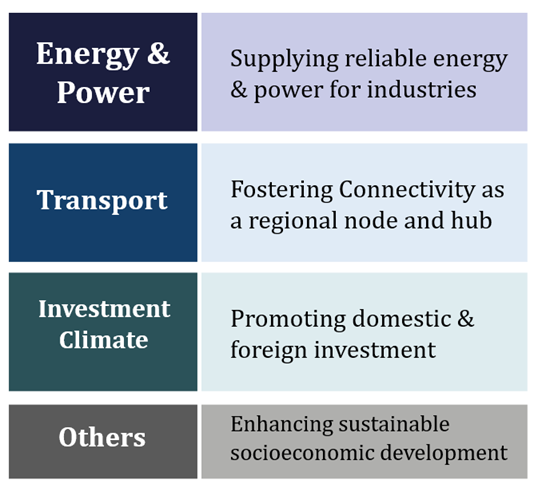
Anchored in the “Japan-Bangladesh Comprehensive Partnership,” Japan committed over US$6 billion in Official Development Assistance (ODA) loans to bolster infrastructure, improve the investment climate, and promote industrial agglomeration along the Dhaka–Chattogram–Cox’s Bazar growth corridor.[14] The initiative is built on three strategic pillars: industrial and trade development, energy infrastructure, and regional economic connectivity.
BIG-B aligns closely with Bangladesh’s “Look East” policy and is compatible with regional cooperation frameworks such as BIMSTEC, BCIM, and RCEP. Beyond economic growth, the initiative envisions Bangladesh as a critical hub linking the Indian and Pacific Oceans, facilitating interregional supply chains and boosting Japanese market access. Japan’s largest-ever ODA package of ¥338 billion in 2022 underlines its long-term commitment to the stability and prosperity of the Indo-Pacific.[15] As major projects near completion, BIG-B is set to drive inclusive development, attract high-value investment, and position Bangladesh as the “Golden Bengal.”[16]
3.3.2 Matarbari Deep Seaport and Prospects of a Southwest Asia Supply Chain Corridor
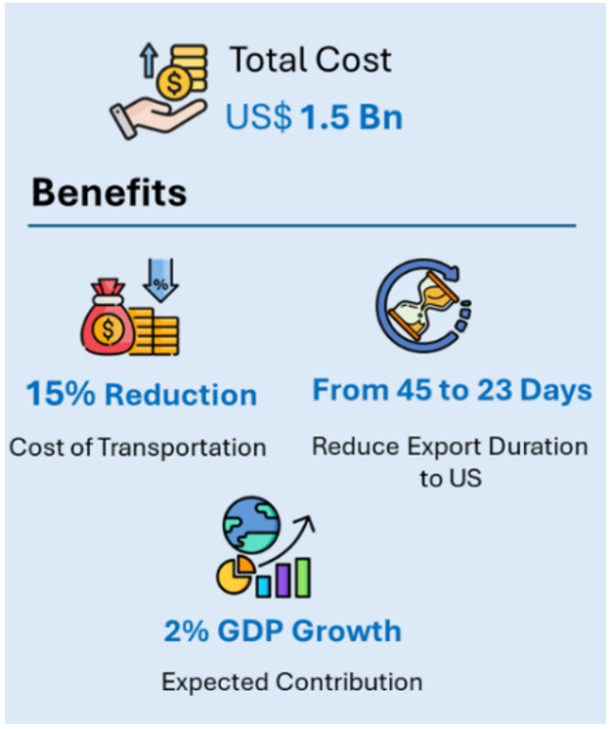 Japan’s strategic infrastructure partnership with Bangladesh is exemplified by the Matarbari Deep Sea Port (DSP) a landmark project transforming the country’s trade and logistics landscape. Located in Cox’s Bazar, this is Bangladesh’s first deep-sea port, and it marks a critical leap toward becoming a maritime trade hub. Initially designed to support a coal-fired power plant, the port’s expanded scope reflects a broader vision of regional connectivity, now backed by a $1.5 billion investment, including a $1.09 billion loan from JICA.[17]
Bangladesh’s shipping infrastructure by accommodating larger vessels and offering faster, cost-effective maritime routes. With 94% of Bangladesh’s trade already reliant on maritime transport, Matarbari DSP is expected to increase trade efficiency, reduce logistical costs, and potentially add 2–3% to GDP, while generating large-scale employment and investment.[18]
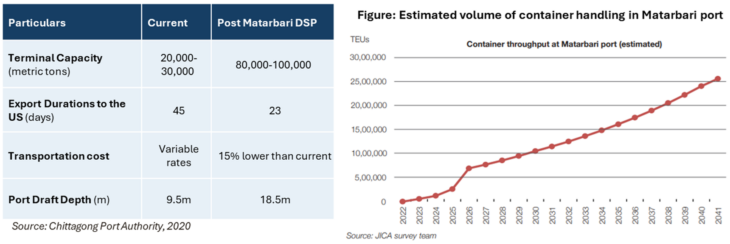
The Matarbari Deep Sea Port addresses Bangladesh’s logistical constraints with the capacity to handle 80,000–100,000 metric ton vessels far surpassing Chittagong’s 20,000–30,000-ton limit and reducing export times to Europe and the US from 45 to 23 days. Featuring automated container systems, deep-draft berths, and advanced logistics platforms, it aims to handle 1.4–4.2 million TEUs annually by 2041 and cut transport costs by up to 15%, boosting export sectors like ready-made garments. Backed by a “3-R Strategy” (road, rail, river), it links efficiently to SEZs and industrial corridors. Enhanced connectivity could raise Bangladesh’s exports to India by 297% and India’s to Bangladesh by 172%.
4.0 Key Challenges Hindering Regional Integration in South Asia
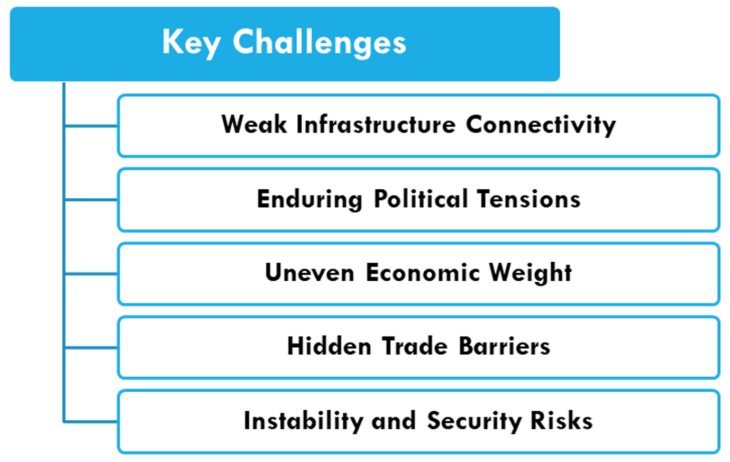
- Weak Infrastructure Connectivity: The lack of efficient transportation systems, poor energy interlinks, and limited digital infrastructure have slowed down cross-border trade and regional coordination.
- Enduring Political Tensions: Deep-rooted geopolitical frictions particularly between India and Pakistan continue to overshadow regional cooperation efforts. The absence of mutual trust has often derailed initiatives under platforms like SAARC.
- Uneven Economic Weight: India’s dominant economic presence, contributing over 70% of South Asia’s GDP, creates an imbalance that raises concerns among smaller economies about equitable benefits from integration.
- Hidden Trade Barriers: Despite formal trade pacts, inconsistent regulations, complex customs procedures, and differing product standards create bottlenecks that restrict seamless economic exchange.
- Instability and Security Risks: Persistent internal conflicts, fragile political environments, and security threats in countries like Afghanistan and Sri Lanka divert attention from regionalism, making sustained collaboration difficult.
4.1 Japan’s Role as a Catalyst for Regional Integration in South Asia
Japan’s continued engagement in South Asia is helping to ease several long-standing barriers to regional integration. Its focus on high-quality infrastructure such as strategic ports, cross-border corridors, and energy links is steadily improving regional connectivity. For instance, in Bangladesh, initiatives under the BIG-B framework including metro rail systems and major infrastructure investments are transforming urban mobility and facilitating trade. Most importantly, Japan’s neutral and steady diplomatic approach offers a platform for fostering regional trust and collaboration. Together, these efforts position Japan as a quiet but powerful catalyst for deeper South Asian integration.
5.0 Way Forward
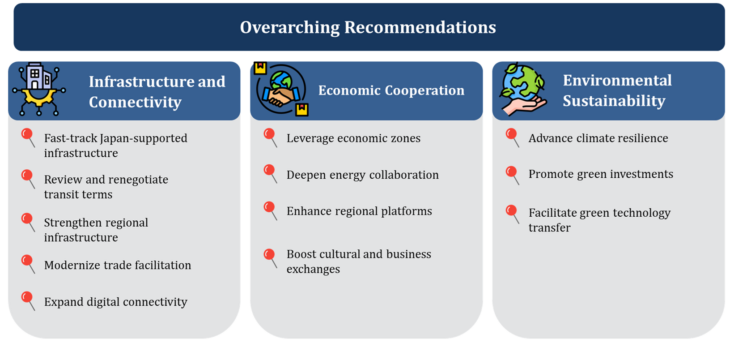
To unlock the full potential of Japan’s role in Southeast Asia’s regional integration, the following strategic actions are recommended, categorized under Infrastructure and Connectivity, Economic Cooperation, and Environmental Sustainability
- Infrastructure and Connectivity
- Fast-track Japan-supported infrastructure: Prioritize the completion of key infrastructure projects, such as the Matarbari Deep Sea Port and Bay of Bengal Industrial Growth Belt, to improve logistics and foster investment.
- Review and renegotiate transit terms: Develop fair revenue-sharing frameworks for transit and port usage, reducing inefficiencies and enabling value-added services.
- Strengthen regional infrastructure: Invest in roads, railways, ports, and logistics through public-private partnerships (PPPs) to eliminate bottlenecks and enhance trade flow.
- Modernize trade facilitation: Develop multimodal transport corridors and digitize customs processes to streamline trade and reduce delays.
- Expand digital connectivity: Invest in cross-border broadband, e-commerce, and fintech platforms to promote market integration.
- Economic Cooperation
- Leverage economic zones: Establish joint industrial parks at key locations and integrated logistics hubs to attract cross-border investments.
- Deepen energy collaboration: Launch joint hydropower and renewable energy projects; create cross-border energy-sharing agreements to support sustainable growth.
- Enhance regional platforms: Actively engage with regional frameworks like BBIN, BIMSTEC, and ASEAN, aligned with Japan’s Free and Open Indo-Pacific (FOIP) strategy to enhance trade, investment, and connectivity.
- Boost cultural and business exchanges: Promote tourism, academic partnerships, and trade fairs to strengthen bilateral trust and collaboration.
- Environmental Sustainability
- Advance climate resilience: Launch collaborative environmental programs, green trade corridors, and renewable energy initiatives to address climate change and foster sustainable development.
- Promote green investments: Encourage Japan’s private and public sectors to invest in sustainable projects such as Circularity, clean energy, waste management, and eco-friendly infrastructure across Southeast Asia.
- Facilitate green technology transfer: Create mechanisms for the transfer of green technologies and practices from Japan to the region, supporting clean industrial processes, energy efficiency, and sustainable agriculture.
[1] Asian Economic Integration Report 2025. Asian Development Bank
[2] Asian Economic Integration Report 2025, ADB
[3] https://idsa.demosl-03.rvsolutions.in/wp-content/uploads/2025/01/book-edited-by-anand-kumar-2025.pdf
[4] Connecting to Thrive: Challenges and Opportunities of Transport Integration in Eastern South Asia.World Bank 2021
[5] Asian Economic Integration Report 2025, ADB
[6] Bangladesh Power Development Board Annual Report 2023
[7] Strategic Investment Roadmap 2023–2030, BIDA
[8] Global Competitiveness Report 2019, WEF
[9] East Asia’s Regional Integration: Political Trust and the Role of Economic Interdependence 2022
[10] ASEAN Political-Security Community Blueprint 2025
[11] Asian Economic Integration Report 2025, ADB
[12] Ministry of Foreign Affairs of Japan, 2023
[13] Japan ODA White Paper 2023, Ministry of Foreign Affairs of Japan
[14] Japan’s ODA Loan Package to Bangladesh, JICA 2022
[15] Japan’s Official Development Assistance White Paper
[16] Japan’s Development Cooperation in Bangladesh: BIG-B Initiative
[17] Blue Economy– Development of sea resources for BD- Ministry of Foreign Affairs
[18] Matarbari A Future Commercial Hub of the Region – Chittagong PortAuthority
 Masrur Reaz
He holds a Ph.D. in Development Economics from the University of Manchester, United Kingdom (2006), and an MBA in Finance from the University of New Orleans, United States (1998). He is affiliated with the Policy Exchange of Bangladesh in Dhaka, where he has been engaged in policy-related research and analysis.
Related posts:
 US-Japan Relations in the Trump 2.0 Era
 Security Cooperation among South Korea, the U.S., and Japan in the Indo-Pacific Era
 Japan – Enhancing Maritime Domain Awareness and International Cooperation
 A Second Journey to Japan: Insights into Trade, Technology, and Territorial Integrity
 Japan’s gesture of goodwill and lessons learnt for Sri Lanka