A Travel to Japan – Fall 2025
Japan is one of the countries that inspires and lives in the imagination of people around the world. Who has never wanted to visit it? This desire seems to connect with Charles Baudelaire’s (1821-1867) poem “Invitation au Voyage” (p.127), in which the verse “tout n’est qu’ordre et beauté” (“everything is but order and beauty”) could very well refer to Japan.
I remembered Baudelaire’s poem during and after my seven-day trip to the cities of Osaka, Hiroshima, and Tokyo in the fall of 2025. A seven-day trip in which I sought to compare the real Japan with what had existed for decades in my imagination. Here I share with you the result of some of the things I felt and experienced during those seven days.
For a career diplomat holding the position of Director of the Institute for International Relations Research (IPRI) at the Alexandre de Gusmão Foundation (FUNAG), the Action Plan for the Japan-Brazil Strategic and Global Partnership, signed during President Lula da Silva’s state visit to Tokyo in March 2025, was the basis and main motivation for a trip that combined personal and professional aspects.
It was a trip that tried to explore various facets of Japanese life through visits to museums, Shinto temples, government offices, and conversations with officials and citizens, including a meeting with a lady who survived the horror of Hiroshima bomb. My intention was to try to see the country from different angles and perspectives. The trip resulted in many memorable and even emotional moments. Here is an incomplete list of some of those moments.
The first stop was Osaka, Japan’s economic center, second largest city, and host of the 2025 World Expo. In addition to getting a first impression of the country, another goal of mine was to visit Expo 2025, one of the world’s largest fairs, where countries showcase their culture and achievements in science and technology. Held on the island of Yumeshima, Expo 2025 had as its main theme “Designing Future Society for our Lives.” In the Brazilian Pavillion, images suggested and/or portrayed folklore, music, culture, nature and urban Brazil, but what caught the most attention was the human warmth and slight smile that lit up the faces of many visitors since Brazil is a country that many people desire to visit one day.
Since their launching in the mid-19th century, World Expos have been a space where people from all over the world meet in a festive and relaxed atmosphere in which they come into contact with the culture and technological and social innovations of the participating countries’ pavilions. Around 28 million people, including 3.5 million foreign visitors visited Expo 2025 in Osaka.
If the Expo in Yumeshima was a rendez-vous with the present and future of humanity, the visit to Osaka Castle was an encounter with Japanese history and tradition. The castle is a Symbol of Japan’s political unification. Events and key figures in Japanese history are vividly present. In Osaka, history is present everywhere, even where you least expect to see it represented, as in some manhole covers that reproduce the image of the castle.
After Osaka, the next stop was Hiroshima. I arrived after traveling on the silent Shinkansen (bullet train), which covered the 320km separating the two cities in about 1 hour and 20 minutes. I had always heard about the punctuality of the Japanese trains and saw this for myself. In Japan, speed and efficiency are just another feature of a country that is both traditional and very modern, with a history that stretches back in time.
Upon arrival in Hiroshima, there is something different that you notice as soon as you get off at the train station. I found myself thinking about the past and what happened in that city in the final stages of World War II. Nowhere else in Hiroshima is the impact of the destruction caused by the atomic bombing of August 6, 1945, more present than at the Hiroshima National Peace Memorial Hall of the Atomic Bomb Victims. It is an impact that leads us to think of the victims and observe a respectful silence for people we never knew, but with who we identify when we think of our own families.
Hiroshima is as modern and developed as other Japanese cities. What makes it special, in my view, is that it remains a living Symbol of certain lessons that should be urgently learned and applied by humanity if it wants to continue do exist. When we see the images of the atomic tragedy, we are shocked by the speed and extent of a destruction never seen before and exacerbated by the secondary effects that dragged on for decades.
Since the tragedy of the atomic bombing of Hiroshima and Nagasaki, the world’s nuclear arsenal has only grown, contrary to what would be the human sense of survival. The explosion of a nuclear bomb instantly annihilates all life around it and turn those who managed to seek refuge in bunkers from survivors into prisoners, who go on to live a sad underground life whose long-term effects we do not even know. There are no winners in a nuclear war.
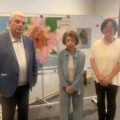
All these thoughts that crossed my mind took shape in the conversation I had with the Director of the Hiroshima Peace Memorial Foundation, Mr. Takehiro Kagawa, and with Mrs. Teruko Yahata, a survivor of the bombing (Hibakusha) who recounts in great detail the events that affected her Family when she was still a child.
Between the two conversations, and walking around the museum and memorial, I saw many young students visiting the place and learning about what happened in Hiroshima and the value of peace. Without peace, nothing truly lasts in the life of a country…
May the nuclear horror never again occur in any country on the face of the Earth. That was the silent prayer I made as I left the Memorial and headed for the Itsukushima Shinto Shrine, located on Miyajima Island in Hiroshima Province. The short boat ride indicated to my interpreter and I that we have arrived at a very special place. The red Torii floating on the water is the Symbol that announces and marks, as many believe, the passage between the material and spiritual worlds.
In his notes on a trip to Japan, the writer and essayist Ilia Ehrenburg tells us about “the Asian inclination toward the profound, toward the search for the Hidden meaning of things; this inclination, which, among Asians, the Japanese also feel, along with a sense of nature and the ability to be joyful, despite their activity and capacity for work (p.131).”
The nature is lush in Miyajima, filling our eyes and making us think about how worthwhile it would be to lead a simple life devoted to contemplation… In addition to Shintoism on the island, we also see the marks left by Buddhism. A religion that, given its very essence, was able to overcome resistance and establish itself in Japan from the 5th century onwards.
In Miyajima, the small shops of the local commerce, nature and temples coexist in perfect harmony, showing us that the material and the immaterial coexist in a harmonious way. Amid these and other reflections, I took the Shinkansen to Tokyo, the last stop of the trip.
In the Japanese capital, a new facet of the trip. The academic field in meetings and seminars with diplomats and academic at institutions such as the Japan Institute of International Affairs (JIIA), the National Institute for Defense Studies, and Sophia University.
The Action Plan for the Japan-Brazil Strategic and Globa l Partnership (2025-2030) lays the groundwork for a fruitful academic dialogue between two countries that have a longstanding relationship of friendship and mutual curiosity. In academic discussions focused on the field of international relations, it is natural for geopolitical and geoeconomic issues to take center stage when dealing with a complex and unstable international scenario such as the one we are currently experiencing.
Indeed, the meeting and seminars had reflected this. Among the topics discussed were, for example, how to address challenges such as global governance reform and the revaluation of multilateralism in an asymmetrical world; the role of Global South and the BRICS in this process; and how to reconcile economic development and environmental Sustainability.
The complexity of the international scenario makes broad and frank dialogue between countries absolutely essential today, since none of them is in a position to solve global problems, no matter how many financial, material and human resources they have. Transnational problems such as climate change, wars, financial and economic crises, to mention just a few examples, cannot be solved by one or a handful of countries alone, as they only have a fragmented view that prevents them from seeing the whole Picture and limits their capacity for action.
In the Brazil-Japan dialogue, I esteem that for the Brazilian side, the originality of Japanese thinking and its enormous capacity of formulating and implementing ideas are elements that enrich this binational debate, for which Brazil is equally ready to contribute. The dialogue finds its materiality in Japanese Brazilian cooperation, which serves the interests of both countries and has been evolving in a solid and creative manner over time. In this process, one cannot forget the influence that Japanese culture has had and continues to have on the culture and formation of the Brazilian people. The positive image that Brazil enjoys in Japan clearly illustrates the centuries-old friendship and respect between the two countries.
In conclusion, I recognize that was a short trip, but enough to nurture reflections and the desire to continue studying Japanese culture. I feel that not only my admiration for Japan, but also my interest in Asia keeps growing, not to mention my conviction about the importance of the ties between Brazil and Japan.
REFERENCES:
Les Fleurs du Mal. Charles Baudelaire, Paris, Librairie Gallimard, 1954, p. 127.
Travel Notes: India, Japan, Greece. Ilia Ehrenburg, Lisbon, Editora Arcádia Limitada, Lisbon, 1967, p. 131.
 Almir Lima Nascimento
Graduated in Law in 1987. Professor at the Rio-Branco Institute (Brazilian Diplomatic Academy) from 2016 to 2020. As a career diplomat since 1992, he served as the head of the Trade Promotion Sector in the Brazilian Embassies in Paraguay, Uruguay, Suriname, and France. Advisor for International Affairs at the Presidency of the Republic of Brazil, Director of the International Relations Research Institute of Fundação Alexandre de Gusmão (think tank of the Brazilian Ministry of Foreign Affairs). Since October 2025 holds the position of Consul General of Brazil in Chengdu (Sichuan, China).